

Before You Vote: The Federal Senate
A Nonprofit’s Guide to Alberta’s October Referendum: The role of Canada’s unelected federal Senate
We explore Question 7 in our series breaking down the 2026 Alberta referendum.
What the Government is Asking
This is the second question on amending the Canadian Constitution. Question 7 asks
“Do you support the Government of Alberta working with the governments of other willing provinces to amend the Canadian Constitution to abolish the unelected federal Senate?”
The ‘7/50’ rule exception
Most constitutional amendments use the ‘7/50 rule’ formula: approval from both houses of Parliament and at least seven provinces representing 50% or more of Canada’s population. Abolishing the Senate is the exception; it would require unanimous consent: both houses of parliament and all ten provincial legislatures.
Voters will be asked to choose yes or no.
A ‘Yes’ vote supports pursuing a constitutional amendment to abolish the federal Senate. This means the government is required to pursue the amendment but doesn’t guarantee its outcome.
A ‘No’ vote supports maintaining the current system which includes the Senate. This means the government should not pursue the amendment, though they can still pursue it through a vote in the legislature. Recent changes to referendum laws removed the referendum pre-requisite for the government to pursue a constitutional amendment.
Question 7 is one of four constitutional questions on the October ballot, which means the result is binding: a majority “Yes” legally obligates the Alberta government to pursue this change, though it cannot force other provinces or the federal government to agree. To abolish the Senate, Alberta would need unanimous agreement between parliament and all the provinces, which is the exception to the 7/50 rule required for other constitutional amendments.
Still, getting approval for the proposed amendment in each of these bodies requires only majority support, not unanimity. A resolution passes with a majority vote, meaning not every Member of Parliament, Senator, or MLA in a participating province needs to agree – just a majority in each body.
Learn More
Visit the Government of Alberta’s website on the referendum here.
Did you know?
Alberta’s longstanding political alternative has been Senate reform through the ‘Triple-E’ model (elected, equal, effective), rather than eliminating the chamber outright.
Why the Government Has Proposed This Change
The Government of Alberta has expressed support for a ‘Yes’ outcome to this question, framing it as a matter of provincial representation. That case rests on two main arguments:
Seat distribution. Alberta holds 6 of the Senate’s 105 seats, whereas the Atlantic provinces hold 30 seats combined, despite having roughly half of Alberta’s population. The government points to this gap as evidence that the Senate under-represents Alberta relative to our population.
The appointment process. Five of Alberta’s current senators were appointed by the federal government without provincial consultation, bypassing the nomination process Alberta created. The government frames this as senators being imposed on Alberta rather than chosen through a process Albertans have a say in.
Both of the government’s stated concerns describe how Senate seats are distributed or filled, not whether a chamber like the Senate should exist. Abolition changes the appointment concerns, but the government hasn’t specified how it resolves disproportionate representation.
Learn More
Imagine Canada has a useful guide for organizations who may want to engage with federal committees.
For Nonprofits
For nonprofits, the Senate is one of the more accessible federal avenues to participate directly in the legislative process. Senate committees can invite organizations to submit testimony and written briefs, offering a way to share frontline knowledge that can inform federal legislation and programming.
Senate committees tend to study issues on a broader scope than the House of Commons. Special Senate committees have previously examined issues like COVID-19, poverty, aging, and employment – areas where nonprofits often have valuable insight to offer, independent of any specific bill in progress.
House of Commons committees work differently. They are generally tied to specific bills moving through the legislative process, on timelines set by the House’s calendar. Because Members of Parliament (MPs) also manage constituency work and face re-election roughly every four years, House committee time and priorities are more likely to be shaped by immediate political pressures.
This doesn’t mean the House of Commons is closed to nonprofit input – organizations can and do submit briefs and testify there too. But the Senate’s broader mandate and longer tenure make it a comparatively easier entry point for organizations without an existing relationship with a sitting MP or bill already on the docket.
As noted above, the government’s stated case for abolition centres on how Senate seats are distributed and filled, not on whether a chamber like the senate should exist. Abolition would be a greater change than the concerns the government has raised: it would remove the committee function altogether, rather than address who sits in those seats or how they got there.
For nonprofits, the practical question is what would take the place of Senate committees as an entry point into federal policymaking. Abolishing the Senate could remove one of the more accessible channels for the sector to contribute frontline knowledge on broad, cross-cutting issues. At the same time, some argue an unelected chamber duplicates scrutiny already underway in the House, or that removing it would streamline rather than weaken the legislative process. For nonprofits who have used Senate committees to submit testimony or briefs, the open question is whether an alternative venue for that kind of broad, non-partisan sector input would emerge, and if so what would it look like?
The Senate and the Sector
In 2018, a Special Senate Committee on the Charitable Sector was formed to examine the impact of laws and policies governing charities and nonprofits in Canada, resulting in 42 recommendations. Among them, the ‘Direction and Control’ test was identified as outdated; in 2022, this led to new federal rules – administered by the CRA – governing how charities fund partner organizations.
Did you know?
Stan Waters was the first Canadian Senator to be “elected” following the Alberta Senate Election in 1989.
About the Senate
Canada’s legislative, law-making, branch has two chambers.
The Senate is made up of appointed, rather than elected members. It is the ‘upper house’, also known as the chamber of Sober Second Thought. It reviews, debates, and proposes improvements to legislation the House of Commons has already passed. Senators are expected to take a more holistic view – one that is apolitical and applies their expertise and long-term thinking – to scrutinize legislation after it’s cleared the elected chamber. The Senate can also introduce its own bills, which then go to the House of Commons for review.
When the Senate was created in 1867, it was intended in part to balance representation in Parliament. The House of Commons represented provinces largely according to population, while the Senate gave less populous regions a stronger voice. Appointed Senators are meant to represent regional interests and populations that may be underrepresented in the elected chamber.
What Does a Senator do?
Senators review and amend bills from the House of Commons and study major public policy issues, from poverty and aging to land use and national defence. They come from a wide range of backgrounds, including Indigenous leaders, doctors, lawyers, judges, scientists, and community leaders.
Members of Parliament are elected to represent the public in their riding – a single, defined slice of a province. Senators represent something broader: the province or region as a whole, bringing experience, expertise from their local communities, and independent review that isn’t already well represented among elected MPs. Because senators aren’t up for re-election, they can raise concerns that may be politically unpopular in the moment, and focus on longer-term impacts rather than the next election cycle.
Much of this work happens in committees, which fall into two types: standing committees (permanent and topic based) and special committees (temporary, created for a specific issue). In committee, senators hear evidence from experts and affected communities and may recommend amendments to legislation.
How Are Senators Appointed?
The Governor General appoints senators on the advice of the Prime Minister; candidates must meet constitutional qualifications (age, citizenship, and residency in the province they represent). Senators can serve until the mandatory retirement age of 75.
In 2016, the Independent Advisory Board for Senate Appointments was created to give the Prime Minister non-binding, merit-based recommendations. The Board includes 3 permanent federal members, and 2 members from the province where a vacancy needs to be filled. Senator appointments remain solely a federal decision, and each province’s input applies only to filling its own seats, not other provinces’.
Alberta is the only province that goes further: since 1989, Albertans have been able to vote in non-binding Senate nominee elections under the province’s Senate Election Act. Winning nominees are put forward to the federal government for consideration when an Alberta vacancy opens. Again, this provincial input is non-binding.
Of the 12 nominees elected across 5 senate elections since 1989, 5 have gone on to be appointed to the Senate. Scott Tannas is the only currently serving senator who came through this process – the other 5 of Alberta’s 6 senators were appointed through the standard federal process without going through Alberta’s election.
Did you know?
Newfoundland and Labrador received 6 seats in the Senate when the province joined the Confederation in 1949.
Alberta’s Representation in Parliament
As mentioned above, the Senate’s founding purpose was to strengthen regional representation and balance the population-based representation in the House of Commons. The government’s case for abolition leans on the seat-distribution argument outlined earlier: Alberta and the other western provinces hold a smaller share of Senate seats than some other regions, relative to population.
There are 105 Senate seats in total, divided among five regions:
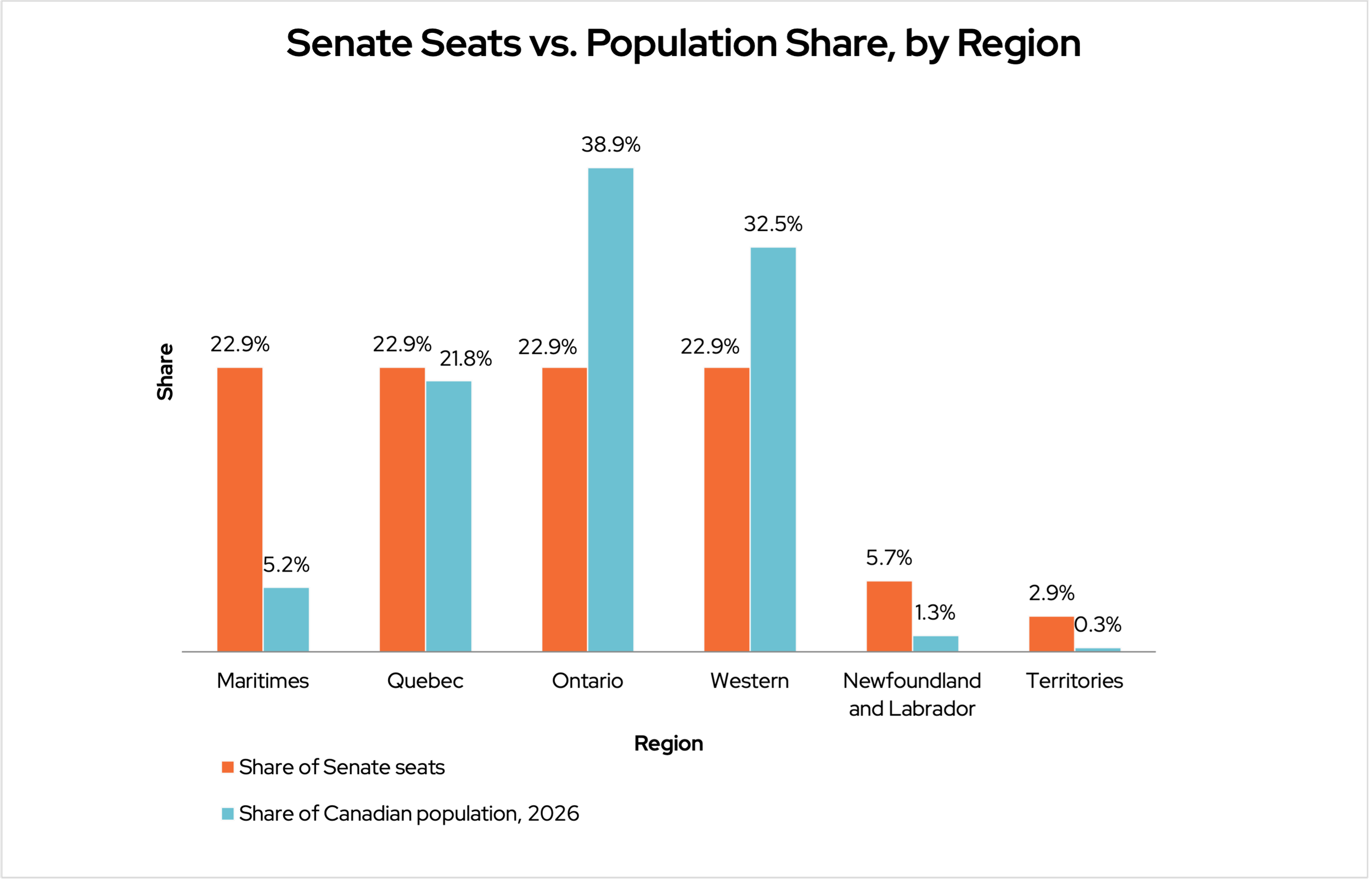
Figure 1: Senate seat distribution compared to provincial population, 2026. Source: Statistics Canada. Table 17-10-0009-01 Population estimates, quarterly
Maritimes: 30 seats (10 for New Brunswick, 10 for Nova Scotia, 4 for Prince Edward Island)
Newfoundland and Labrador: 6 seats
Quebec: 24 seats
Ontario: 24 seats
Western: 24 seats (6 each for British Columbia, Alberta, Saskatchewan, and Manitoba)
Territories: 3 seats (1 for Northwest Territories, 1 for Yukon, 1 for Nunavut)
Six senators represent Alberta.
Figure 1 shows why this draws criticism: the Maritime provinces hold more than four times their population share in Senate seats, while Ontario and the Western provinces hold noticeably less than theirs. This gap exists because Senate seats were fixed by region and have stayed largely unchanged since 1915 – when Alberta and the other western provinces were each allocated 6 seats – even as the country’s population has shifted west and to Ontario since then. House of Commons seats, by contrast, are redistributed after every census to track population change.
How Nonprofits Can Get Involved
Interested in learning more about how you and your organization can get involved? See our post on the rules of engaging with the referendum, so that you and your organization can advocate responsibly.
Stay tuned for the next post. If you have any questions, reach out to us - policy@thenonprofitchamber.org