

Before You Vote: Provincial Courts and Justice Selection
A Nonprofit’s Guide to Alberta’s October Referendum: A question of who should appoint judges.
We explore Question 6 in our series breaking down the 2026 Alberta referendum.
What the Government is Asking
This is the first question on amending the Canadian Constitution. Question 6 asks:
“ Do you support the Government of Alberta working with the governments of other willing provinces to amend the Canadian Constitution to have provinces, not the federal government, select the justices appointed to provincial King’s Bench and Appeal Courts?”
What This Means
Recent changes to referendum laws removed the referendum pre-requisite for the government to pursue a constitutional amendment.
Voters will be asked to choose yes or no.
A ‘Yes’ vote supports pursuing a constitutional amendment that would give provinces the authority to appoint provincial superior court judges. This means the government is required to pursue the amendment but doesn’t guarantee its outcome.
A ‘No’ vote supports maintaining the current approach, where the federal government appoints the judges of the provincial superior courts. This means the government should not pursue the amendment, though they can still pursue it through a vote in the legislature.
This October, Albertans will vote on whether the provincial government, rather than the federal government, should appoint judges to Alberta's two superior courts. Under the Constitution, that authority currently belongs to the federal government.
Question 6 is one of four constitutional questions on the October ballot, which means the result is binding; a majority “Yes” legally obligates the Alberta government to pursue this change. It cannot force other provinces or the federal government to agree to the change, which is required for a constitutional amendment.
To make the amendment, Alberta needs to meet the 7/50 formula: approval by the House of Commons, the Senate, and at least seven provinces representing at least 50% of Canada’s population.
Getting approval for the proposed amendments in each of these bodies requires only majority support, not unanimity. A resolution passes with a majority vote, meaning not every Member of Parliament, Senator, or MLA in a participating province needs to agree – just a majority in each body.
Learn More
Visit the Government of Alberta’s website on the referendum here.
Did you know?
Australia and the US select judges at the State level. Germany involves both federal and state representatives in selection, while Wales and England select judges through a Judicial Appointments Commission - created in part to make appointments more independent from government.
Why the Government Has Proposed This Change
The government is supportive of a ‘Yes’ outcome for this question.
Right now, judges for Alberta’s Court of Appeal and Court of King’s Bench - the province’s superior courts – are chosen by the federal government in Ottawa. The government argues that Canada is an outlier, noting that many Western countries allow judicial appointments to be made by the level of government closer to the courts, rather than by the central government. Quebec has proposed a similar constitutional amendment, while Ontario and Saskatchewan have supported greater provincial involvement in the appointment process.
The government’s case for the change centres on a few points. It points to strain on Alberta's courts, arguing that provincial appointments could speed up the process of filling vacancies with qualified candidates and help ease pressure on the court system. The government also sees provincial appointments as a way to give Albertans more input into who serves on courts that shape justice in their communities. Finally, they make the case that a provincial appointment process will be more transparent and accountable, while strengthening judicial independence.
The March Motion vs. the October Referendum
In March 2026, the Alberta legislature passed a non-binding motion asking the federal government to amend the Constitution so that judges appointed to Alberta’s Court of King’s Bench and Court of Appeal would be chosen only from a shortlist recommended and approved by the province, with the federal government still making the final appointment decision. The October referendum question asks Albertans something bigger: whether the province should pursue the power to appoint those judges itself, not just narrow the federal government’s shortlist.
For Nonprofits
The Court of King’s Bench and the Court of Appeal are where organizations might go to challenge a government decision, defend a right, or shape how a law applies. Whoever selects these judges is shaping the bench that may one day hear a case affecting you or your organization.
How much this question matters depends on your organization's relationship to these courts – whether you’re in court yourself, or affected by the what the courts decide:
You could be a litigant by bringing or back legal challenges in court. This could include a judicial review of how a decision was made, a constitutional challenge to a law itself, or a challenge to eligibility and delivery of services and programs.
Your nonprofit could also be an intervenor, making submissions in someone else’s case to build understanding for the court.
Or, you might not directly interact with or appear in the courts at all. Instead, your organization, your members, or your clients, could be affected by court decisions – including those touching individuals’ rights or eligibility for services.
For the nonprofit sector, this question is ultimately about trust in and access to the justice system. The issue is not just who appoints judges, but whether the appointment process helps ensure courts are seen as independent, impartial, fair and able to hear cases in a timely manner.
Current Examples of the Courts in Action
In the past year, civil society groups, Indigenous Nations, and the provincial government have found themselves on opposite sides of legal disputes in these very courts.
The Court of King's Bench reviewed a proposed citizen-initiative question on Alberta separation and found it unconstitutional, focusing on its failure to safeguard First Nations treaty rights. A Treaty 8 First Nation was among those bringing related challenges. On June 11, the province filed an appeal - the judge allowed for petition signatures to be verified, but as of August 26, 2026 the matter is still in front of the Court of Appeal.
Separately, two advocacy nonprofits challenged a provincial law restricting gender-affirming care for youth, on behalf of affected families. That case shows the courts cutting both ways: the King's Bench first granted an injunction pausing the law, then lifted it after the province invoked the Charter's notwithstanding clause and later declined to let the challenge be reframed as a federal matter because healthcare is within provincial jurisdiction.
What This Means
This process means provinces have authority over local court operations, while federal appointment means judges are selected across the country with the same standards and processes within a larger, unified Canadian legal system.
What Are the Courts and How Are They Appointed?
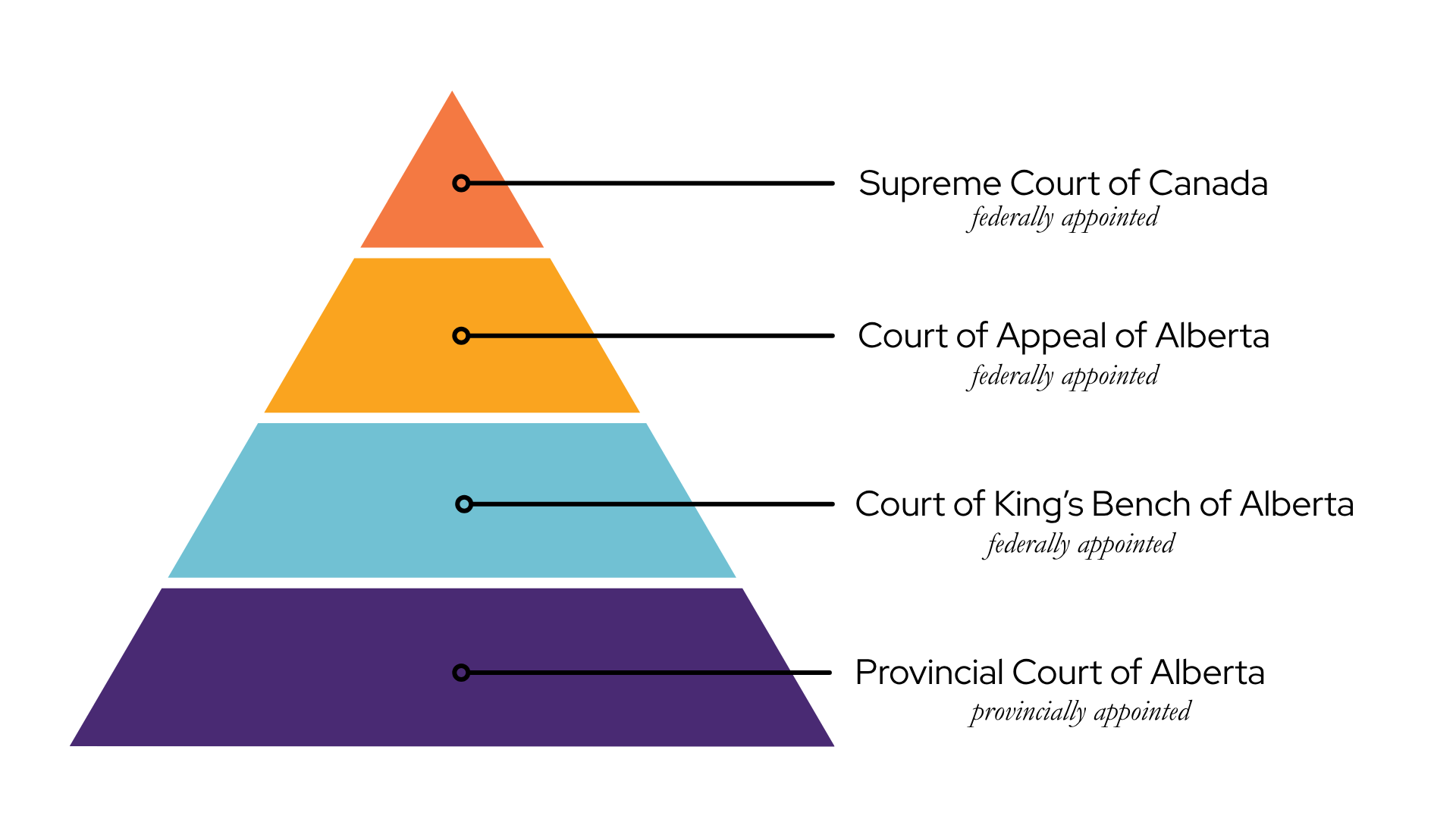
Figure 1: Alberta’s Court System
Alberta has two superior courts and one provincial court. The province administers all three – pays for and operates the court facility, sets court procedures, maps judicial districts – but their judges are appointed differently.
The Court of Appeal and Court of King's Bench are Alberta's two superior courts. The Court of Appeal is the province's highest court, while the King's Bench is its superior trial court, hearing serious criminal and civil cases and reviewing government decisions. Among their many roles, these courts can determine whether provincial laws comply with Canada's Constitution. Their judges are appointed and paid by the federal government, following review through an Alberta judicial advisory committee.
The Alberta Court of Justice is the entry point for most legal matters, including family, traffic, youth, criminal, and smaller civil cases. Its judges are appointed by the provincial government through Alberta's judicial appointment process.
The province argues that by strengthening provincial powers, it will ensure Albertans have a voice in appointments “that shape how justice is delivered in our communities”.
One line of argument holds that the province is better positioned to identify judges with relevant local experience, and that provincial selection would let the justice system better reflect Alberta’s priorities. A different line holds that courts are not intended to reflect provincial preferences – they are expected to stay independent, apply the law impartially, and sometimes rule against governments as a check on their power. However, federal appointment doesn’t guarantee impartiality on its own either; it relies on appointment processes and professional standards designed to support judicial independence and public confidence.
Filling Vacancies in Superior Courts
The province argues that provincial appointment power could help fill judicial vacancies more quickly. The issue is not necessarily a shortage of qualified candidates; Alberta's advisory committee already identifies a pool of eligible applicants. Rather, delays by the federal government to act on that pool when a vacancy opens has previously been a documented problem. In May 2023, the Supreme Court Chief Justice warned then Prime Minister Justin Trudeau that judicial vacancies had reached a level threatening trials and public confidence in the justice system. A subsequent federal court case, Hameed v. Canada (2024), found the federal government had failed to fill vacancies within a reasonable time – though that ruling was later overturned on appeal in 2025, leaving the legal question of how quickly Ottawa must act unresolved.
The documented delays raise a separate question: would changing who makes the appointments also change how quickly they are made? The referendum proposes changing who holds appointment power, but does not itself establish a timeline for filling vacancies.
Judicial Independence
Judicial independence means judges decide cases based on the law, not political pressure. Two things protect it today:
First, the appointment process itself: an arm’s-length-from-government committee screens applicants for merit before any political figure gets involved, and judges are appointed, rather than elected so decisions rest on law rather than popularity.
Second, the set of protections a judge holds after appointment: security of tenure to age 75, a salary neither government can manipulate, and administrative independence over how courts assign cases and staff. Together these bind judges to the law and constitution regardless of who appointed them.
The province argues that provincial appointment powers would make the process more transparent, accountable, and would reinforce judicial independence, but have not specified how increased provincial powers would change this.
How Nonprofits Can Get Involved
Interested in learning more about how you and your organization can get involved? See our post on the rules of engaging with the referendum, so that you and your organization can advocate responsibly.
Stay tuned for the next post. If you have any questions, reach out to us - policy@thenonprofitchamber.org