

Budget 2026: What It Means for Alberta’s Nonprofit Sector
Budget 2026 was released last Thursday, and we’re breaking it down for nonprofits.
We start with an overview before diving into the details. In the sections that follow, we unpack what the budget documents tell us, how government priorities are reflected, the key highlights to note, and the implications for the nonprofit sector.
Overview
Economic Growth and Service Efficiency Remain a Priority
This budget prioritizes economic growth alongside services for Albertans. It reflects Mandate Letters released in November, re-iterating priorities such as red tape reduction and safeguarding provincial jurisdiction. We see structural changes to health delivery and a shift in focus to resource development within Indigenous Relations. Across ministries, services and programs are expected to be assessed for efficiency and effectiveness as the government seeks to identify where savings can be found without comprising core priorities.
Structural Shifts May Reshape Funding Flows
The Province is projecting deficits over the next three years. At a high level, we have not seen major cuts to ministries that interact closely with nonprofits, and are seeing substantial increases to Health and Education alongside rising demand.However, with structural changes to programs and services, and more reviews of programming still to come, nonprofits can expect changes in the ways funds are distributed in the future.
Flat Funding in the Time of Growth
In the context of continued population growth and inflation, flat or marginally increased funding could function much like a funding reduction in practice. As service demand and costs rise, how ministries allocate and coordinate funding internally will matter as much as overall budget totals. The strategic and business plans for ministries outline what will be prioritized for the next year.
New Funding and Initiatives Create Opportunity
Of the ministries we reviewed, only Environment and Protected Spaces saw a decrease in nominal dollars (not adjusted for inflation or population growth). Reductions to Arts, Culture and Women reflect the conclusion of a CFEP top-up rather than a structural cut, while The Alberta Foundation for the Arts saw an increase. New initiatives budgeted for this year include Higher Ground: A Tourism Strategy and the Alberta Disability Assistance Program (ADAP), which will operate alongside Assured Income for the Severely Disabled (AISH).
Budget Documents and What They Tell You
Here are the documents that get published when the Province releases its budget, and what they tell us:
Strategic Plan: This is where the government outlines its priorities. Use this to understand the government’s stated focus, where your organization or sector aligns, where it doesn’t, and make advocacy, government relations and communications plans accordingly.
Fiscal Plan: Use this to understand ministerial funding, at a high level, over the next three years.
Business Plans: Business plans dive into more detail for each ministry. They set out priorities, desired outcomes, performance metrics, and additional details in ministerial budgets. We encourage you to read the business plan for the Ministries you work with most closely. Ministerial Mandate Letters are another good tool for understanding Ministerial priorities. Keep an eye out for alignment – or lack thereof – of priorities across Mandate Letters and Business Plans, and ask your Ministry contracts if there is a lack of alignment relevant to you.
Estimates: This is a line-by-line budgeting by Ministry, which MLAs will vote on when deliberating the budget. Use this to understand the detailed programs and projects within each Ministry.
Government Priorities
The Government’s 2026–29 Strategic Plan organizes everything into two overarching priorities:
1. Maintaining Alberta’s Advantage
Þ Responsible fiscal management and spending discipline
Þ Reducing administrative burden (“red tape”)
Þ Maintaining Alberta’s tax advantage
Þ Investment attraction and economic diversification
Þ Protecting jurisdiction over energy and natural resources
2. Supporting Albertans
Þ Modernized health care
Þ Mental health and addiction recovery
Þ Childcare and education
Þ Safe communities
Þ Supporting vulnerable Albertans
Þ Indigenous partnerships
Þ Building better communities
Budget Highlights
We have not seen major cuts to most ministries that interact closely with nonprofits – though, in a growing province, flat or modest increases may function as reductions once inflation and population growth are considered.
Nonprofits can expect structural changes in the way ministries allocate grants and contracts that could change the nature of their work and/or eligibility for funding. The provision of health services, for example, is already undergoing large structural changes, and the government has committed to reviewing other programs and grants for their effectiveness and efficiency.
Health and Education see substantial increases associated with increasing demand, while funding to Environment and Protected Areas is down ~8% and contingency funding for Forestry and Parks is not renewed – this as Alberta experiences more floods, wildfires and droughts.
Arts, Culture and Status of Women
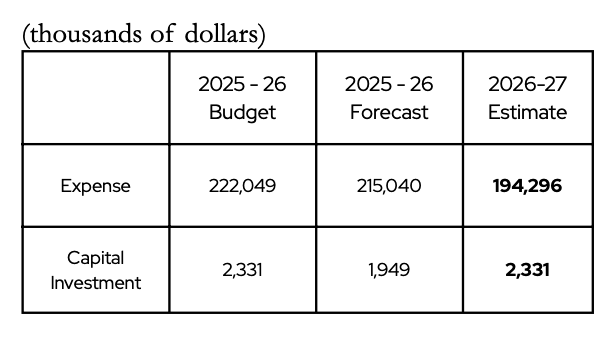
Spending reflects the conclusion of the CFEP top-up rather than a broad structural reduction. The Alberta Foundation for the Arts has received an increase, aligning with government messaging about supporting cultural industries and tourism. Capital allocations decline in 2026-27. As always, program-level criteria will matter more than topline figures.
Assisted Living and Social Services
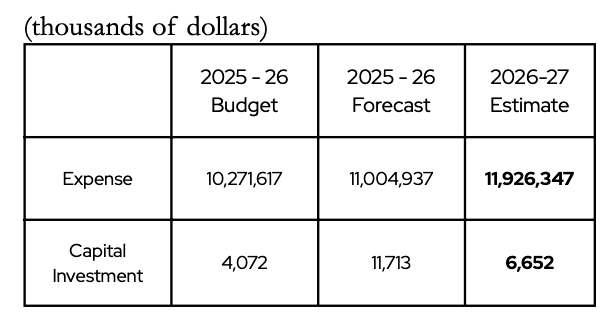
This ministry sees significant growth over the next two years. The ministry highlights system modernization, disability programming changes (including the Alberta Disability Assistance Program operating alongside AISH), and supports for vulnerable Albertans. Nonprofits delivering disability, housing, income support, seniors, or community-based services should monitor program transitions closely, particularly eligibility rules and administrative processes.
Children and Family Services
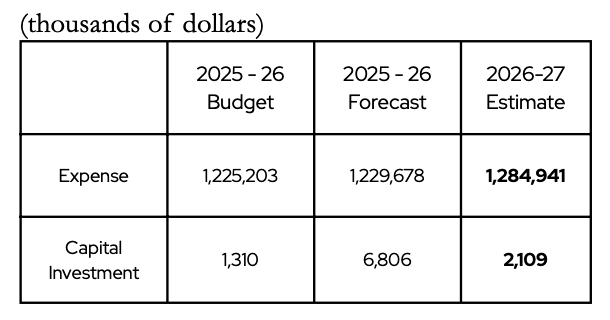
Modest operating increases are projected, consistent with messaging around child intervention reform and prevention-focused approaches. For nonprofits providing family support, kinship care, or prevention programming, the key question will be whether funding shifts toward early intervention and community-based delivery models.
Education and Childcare
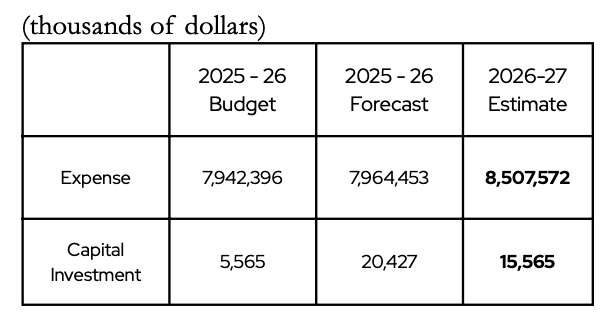
Education spending increases significantly in 2026-27, reflecting enrolment growth and classroom capacity pressures. Government messaging emphasizes infrastructure, teacher workforce capacity, and childcare affordability. Nonprofits working in out-of-school programming, childcare delivery, or school-based partnerships may see opportunities tied to expansion, though demand pressures are likely to remain high.
Environment and Protected Areas
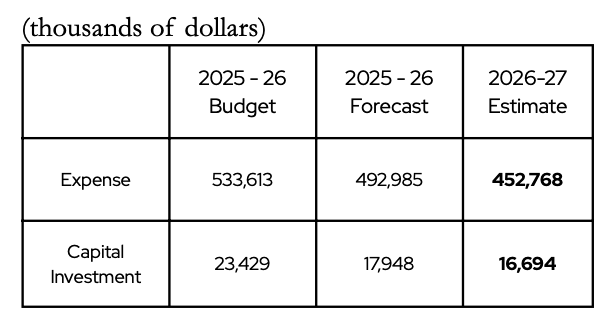
This ministry shows a decline in nominal operating dollars over the period reviewed. Sector materials emphasize regulatory efficiency and resource development alongside environmental stewardship. Environmental nonprofits may wish to watch how regulatory changes, monitoring, and conservation initiatives are resourced in practice — particularly in the context of wildfire risk and climate adaptation.
Forestry and Parks
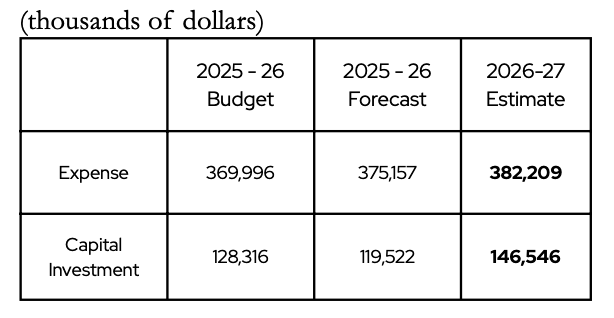
Operating spending increases modestly, with stable capital allocations. Messaging highlights wildfire management, forestry modernization, and park access. The 2025-26 forecast included $768 million in non-recurring wildfire response contingency. Given recent wildfire impacts across sectors, implementation and suppression capacity will be closely watched by both nonprofit and private sector partners. Natural disaster events have placed increasing pressure and costs on housing, insurance, infrastructure, tourism, and social services simultaneously.
Hospital and Surgical Health Services
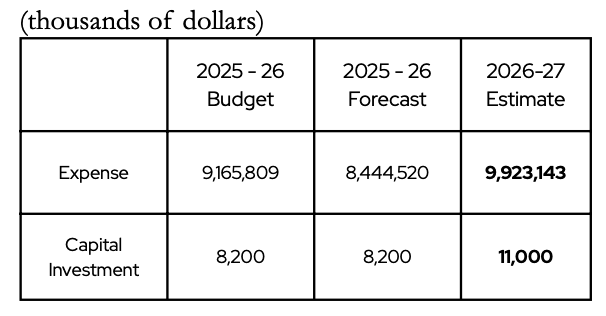
Spending increases in 2026-27 following a forecast dip. Government communications emphasize surgical capacity, system restructuring, and wait-time reductions. Health-focused nonprofits may experience system transition impacts as service delivery structures evolve.
Indigenous Relations
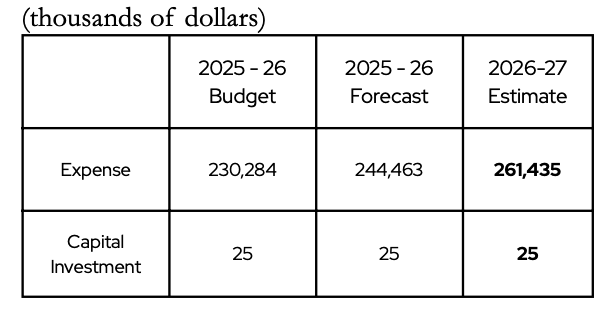
Operating funding increases steadily. Messaging places emphasis on economic reconciliation, resource development partnerships, and Indigenous participation in major projects.
Justice
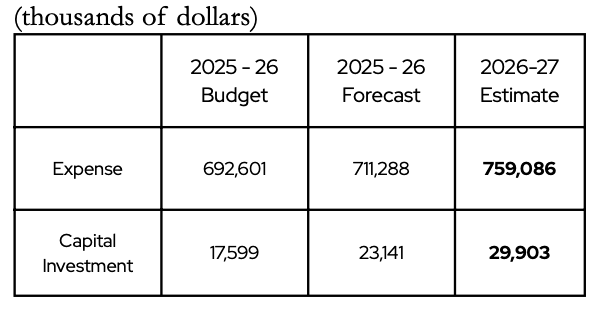
Spending increases over the period reviewed, consistent with priorities around public safety and system efficiency. Community-based justice organizations, restorative justice programs, and victim support services may wish to monitor funding streams and policy shifts tied to justice system reform.
Mental Health and Addictions
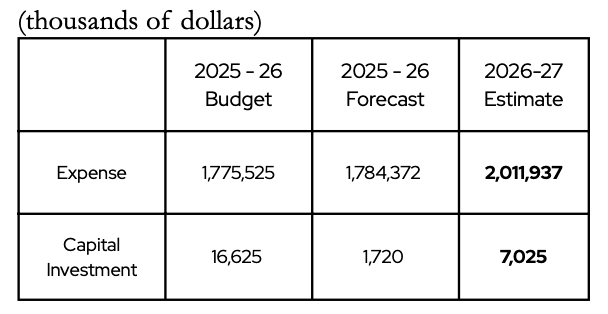
Operating funding increases substantially in 2026-27, though capital funding declines. Government materials highlight recovery-oriented models and system restructuring. Nonprofits delivering front-line mental health and addiction services should watch how new service pathways and procurement processes affect community-based providers.
Public Safety and Emergency Services
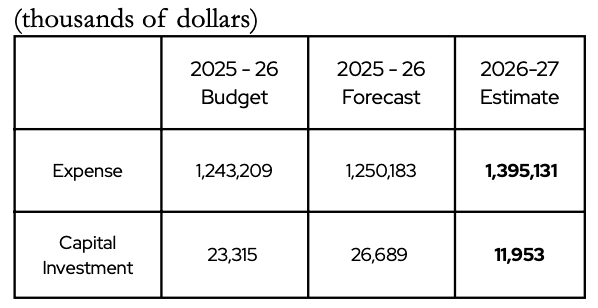
Public Safety and Emergency Services spending increases in 2026-27, reflecting investments in both emergency preparedness and enforcement capacity. Government materials emphasize disaster response and community safety, alongside priorities related to policing, sheriffs, and justice system efficiency. At the same time, nonprofits working with vulnerable populations may wish to monitor how enforcement-focused investments intersect with community-based prevention, diversion, and social support programs.
Tourism and Sport
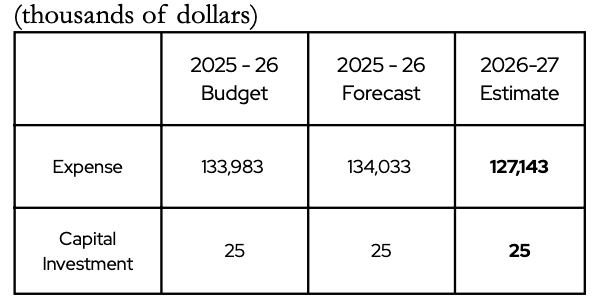
Operating funding remains relatively stable. The introduction of Higher Ground: A Tourism Strategy signals a focus on tourism as an economic driver. Arts, cultural, sport, and community event organizations may find opportunities where programming aligns with provincial tourism priorities. Environmental organizations may want to monitor how this strategy aligns with changing regulation. Funding for this ministry dedicated to Sports and Recreation sees a modest increase in operating funding, and a decline in capital funding.
Nonprofit Sector Implications
A. Efficiency and Outcomes Are Central
This language aligns directly with what the Nonprofit Chamber flagged in its mandate letter analysis:
Greater scrutiny of grants
Stronger performance orientation
Focus on measurable results
Emphasis on efficiency in public spending
Nonprofits should expect:
Increased outcome reporting expectations
Potential shifts toward performance-informed funding
Questions about program necessity and cost-effectiveness
Deficit conditions + fiscal discipline language = accountability tightening.
B. “Red Tape Reduction” Is a Policy Signal
The government highlights a 34% reduction in red tape since 2019.
The sector can argue that:
Multi-year funding reduces administrative churn
Simplified reporting frameworks increase service efficiency
Prevention funding reduces downstream system “red tape”
C. Economic Growth Is the Anchor Narrative
The Strategic Plan repeatedly ties public investment to:
Labour market participation
Investment attraction
Productivity
Skilled workforce development
Nonprofits must increasingly position themselves as:
Labour market stabilizers
Workforce participation enablers
Risk-reduction infrastructure
D. Performance Indicators: What Government Will Measure
The Strategic Plan lists performance indicators including:
Private sector employment growth
Housing starts
Investment levels
Net debt-to-GDP
Surgical wait times
Mental health beds per capita
Crime rates
Notice what is absent:
Nonprofit sector sustainability
Community capacity measures
Nonprofit Workforce Strategy and Talent Pipeline
Nonprofits are embedded in delivery — but not measured as infrastructure
The Opportunity
Nonprofits are visible in the government’s priorities, but are not necessarily centered.
Budget 2026 and the 2026–29 Strategic Plan reveal a government focused on:
Economic advantage
Fiscal discipline
Modernized service delivery
Public safety and system performance
The nonprofit sector is essential to delivering these outcomes, but is not explicitly recognized as system infrastructure.
The opportunity for Alberta nonprofits is to:
Align with the government’s priority language
Demonstrate measurable impact
Advocate for structural stability
Position prevention as economic and fiscal strategy
Make nonprofits explicitly and clearly visible as vital partners in achieving government outcomes